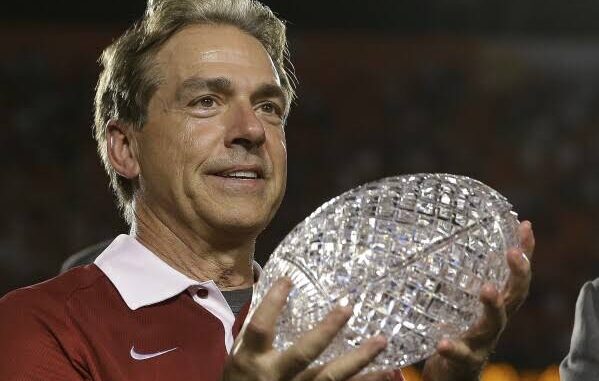
NEW YORK, NY – In a ceremony celebrating decades of unparalleled excellence and profound influence, legendary former University of Alabama head football coach Nick Saban was honored last night with a prestigious Lifetime Achievement Award for his monumental contributions to college football. The accolade recognizes not only his record-setting seven national championships but also his lasting impact on the sport’s coaching philosophy, player development, and the very fabric of collegiate athletics.
The award was presented at a star-studded gala, attended by prominent figures from across the sports world, former players, coaching peers, and luminaries from higher education. The event underscored Saban’s status as arguably the greatest coach in college football history, a figure whose “Process” redefined success and left an indelible mark on generations of athletes and coaches.
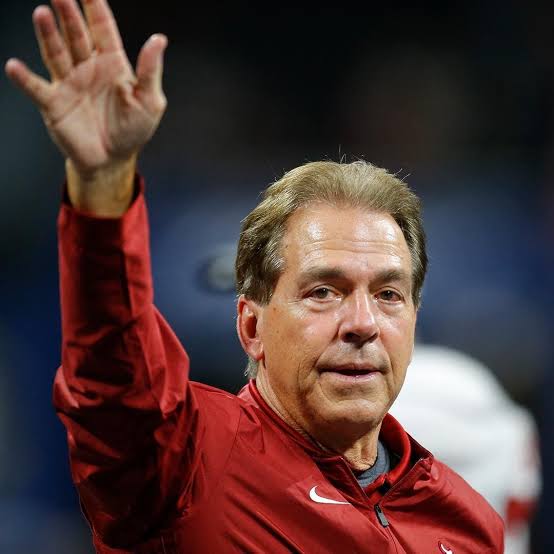
During his illustrious 28-year career as a collegiate head coach at Toledo, Michigan State, LSU, and most notably Alabama, Saban amassed an astounding 292-71-1 overall record. His seven national championships – one with LSU (2003) and an unprecedented six with Alabama (2009, 2011, 2012, 2015, 2017, 2020) – set a new standard for excellence in the modern era of college football. He holds the distinct honor of being the first coach in history to win national titles at two different Football Bowl Subdivision (FBS) schools since the inception of the AP Poll in 1936.
Speakers at the ceremony lauded Saban’s relentless pursuit of perfection, his strategic genius, and his unwavering commitment to developing young men both on and off the field. Numerous former players, many of whom went on to achieve significant success in the NFL, shared anecdotes illustrating Saban’s demanding yet ultimately transformative mentorship.
His emphasis on discipline, preparation, and accountability became a hallmark of his programs, producing not only championship teams but also a remarkable 66 First Team All-Americans and four Heisman Trophy winners at Alabama alone (Mark Ingram II, Derrick Henry, DeVonta Smith, and Bryce Young).
Beyond the staggering win totals and championship trophies, Saban’s influence extends to his expansive coaching tree, which has seen more than 35 of his former assistant coaches go on to become head coaches in college and the NFL. This testament to his ability to identify, develop, and empower coaching talent further solidifies his legacy as a true architect of the game.
His “Process,” a meticulously crafted system focused on consistent effort, attention to detail, and a focus on the present moment, became a blueprint for success copied by programs across the nation. It emphasized incremental improvement and mental fortitude, aspects that transcended the X’s and O’s of football and resonated deeply with his players.
Beyond the sidelines, Saban and his wife, Terry, have made significant philanthropic contributions through their Nick’s Kids Foundation, distributing over $13 million to more than 150 charities. Their charitable work has included rebuilding homes for Habitat for Humanity after the devastating Tuscaloosa tornado and significant donations to support first-generation scholarships and various community causes.
His latest initiative, the Saban Center, aims to house a STEM Discovery Center and the Alabama STEM Hub, showcasing his commitment to education and community development.
Saban’s induction into the College Football Hall of Fame as part of the 2025 class was announced earlier this year, further cementing his place among the sport’s immortals. This Lifetime Achievement Award serves as another fitting tribute to a career that not only dominated the scoreboard but profoundly impacted the landscape of college football. His retirement from coaching earlier this year marked the end of an era, but his influence will undoubtedly continue to shape the sport for generations to come.


Be the first to comment