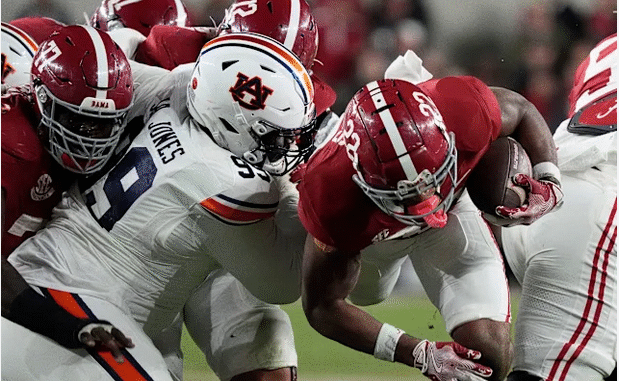
The Iron Bowl, the annual clash between the University of Alabama Crimson Tide and the Auburn University Tigers, has long transcended a simple football game. It’s a seismic event in the state of Alabama, a cultural touchstone that for one day each year, consumes the attention of millions. But what elevates this rivalry from a regional feud to one of the most compelling narratives in all of sports are the moments of sheer, unscripted chaos that have come to define it. Two plays, in particular, stand out as monuments to the rivalry’s volatile nature: “Punt Bama Punt” and “The Kick Six.”
Fifty-three years before the “Kick Six” cemented its place in college football lore, the 1972 Iron Bowl delivered a different kind of miracle.
Undefeated, second-ranked Alabama, led by the legendary Bear Bryant, was a 14-point favorite over an underdog Auburn squad. For most of the game, the script held. Alabama led 16-0 deep into the fourth quarter, and the Crimson Tide’s perfect season seemed all but assured.
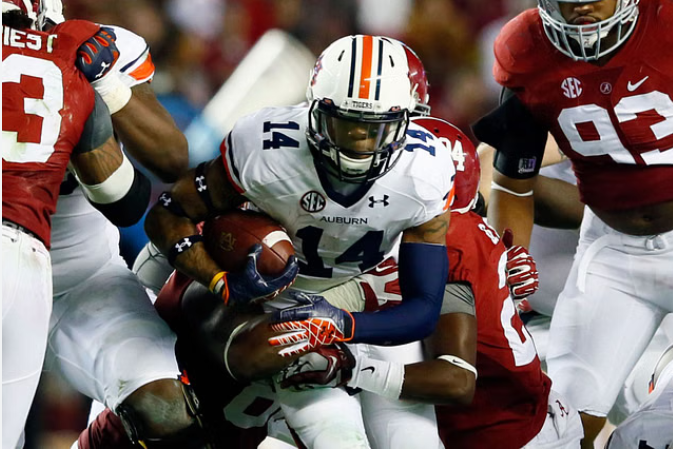
But the Tigers, known as “The Amazin’s” that year, refused to quit. After a field goal cut the deficit to 16-3, they needed a miracle. And they got not one, but two. Auburn’s Bill Newton, a defensive end, blocked back-to-back punts by Alabama’s Greg Gantt. The first was recovered by David Langner and returned 25 yards for a touchdown.
On the ensuing possession, the same sequence unfolded, with Newton blocking another punt that was again scooped up by Langner for a score. The two improbable touchdowns, coupled with a successful extra point, gave Auburn a shocking 17-16 lead. The Tigers held on, and an unranked Auburn team handed the national championship-bound Crimson Tide one of the most stunning defeats in their history. The game’s iconic radio call, “It is blocked! It is blocked!” is still a rallying cry for the Auburn faithful.
Fast forward to November 30, 2013. The stakes were arguably higher than ever. Top-ranked Alabama, gunning for a third consecutive national title, faced fourth-ranked Auburn in a game with SEC Championship and national title implications. With the score tied at 28, and a single second on the clock, Alabama attempted a potential game-winning 57-yard field goal.
Alabama coach Nick Saban had successfully lobbied for one second to be added to the clock after a run by Alabama’s T.J. Yeldon seemingly ended the game. It was a decision that would haunt him. The kick was short. On the other side of the field, Auburn’s punt returner, Chris Davis, had been placed in the back of the end zone just in case.
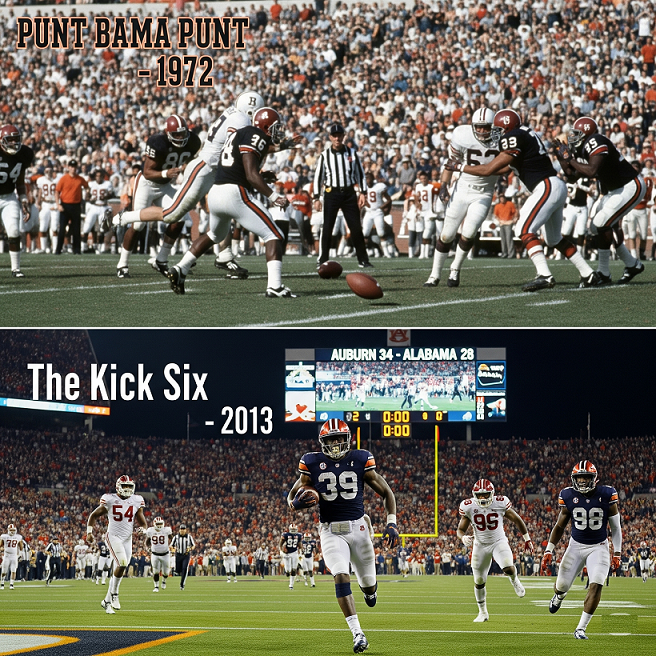
The ball fell short, and Davis caught it in stride. In a breathtaking 109-yard dash down the sideline, he weaved through a stunned Alabama kicking unit for a game-winning touchdown as time expired. Auburn won 34-28, a victory that sent Jordan-Hare Stadium into a frenzy and ended Alabama’s dynasty-defining season. The play, immortalized as “The Kick Six,” is now widely regarded as one of the greatest and most improbable endings in college football history.
These two games, separated by more than 40 years, illustrate the core of the Iron Bowl rivalry. It’s a rivalry where logic is suspended, and the unimaginable becomes reality.
Whether it’s the methodical, improbable success of “Punt Bama Punt” or the spontaneous, explosive thrill of “The Kick Six,” the Iron Bowl proves that in the state of Alabama, football is more than a game—it’s a dramatic stage where legends are born and unforgettable moments are carved into history.

Be the first to comment